
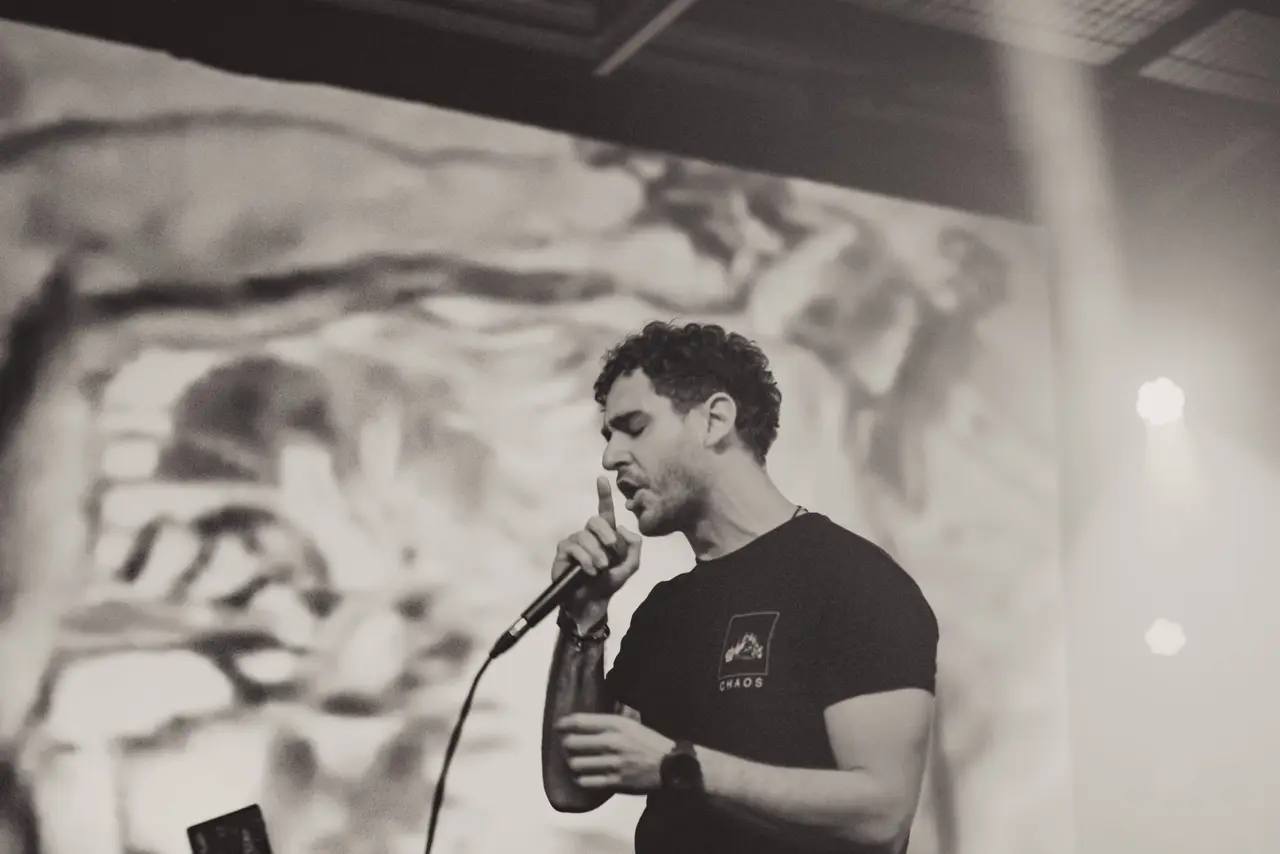
Interview by: Ruth G. Núñez de Arenas
With a path shaped by sonic introspection and a musical identity that resists easy classification, Alpha Sect has become one of the most compelling voices in the European underground. From his roots in Greece’s punk and post-metal scenes to his evolution into a sound where EBM, darkwave, and experimental electronics converge, the artist invites us into his world — a space of catharsis, meticulous detail, and a constant search for meaning. In this interview, we dive into his beginnings, influences, creative process, and the scene that surrounds him. An intimate journey into the heart of his sonic sect.
Why Alpha Sect?
This is like an invitation to something really personal and deep concerning the music. To start with the idea behind Alpha Sect is the importance that music has for me, the importance that music has for me in my life. Music, I started, you know, my parents bathed me into music, into classical music, into Greek music, into all kinds of music, rock.
So you have had contact with music since you were a child?
Totally, totally. I grew up, I have photos of me when I was young with me having like the old Walkman, with cassettes, tapes, and listening to it when I was like five, six, not even five, six years old. So, I was always into music, and music is a really important place in my life. I went by different stages of different genres of music, from rock, metal, metalcore, hardcore to electro, more commercial, minimal, you know, it was this in 2010, this minimal vibe with Extrawelt, and afterwards you have this psychedelic trance everywhere, in Greece at least, between 2010 and 2014. So, I was really listening and getting a lot of influences, and I was playing in a band at that moment, like I was playing post-rock and post-metal as a guitarist, I started learning music with the piano first, and then I went to the guitar, and then back to the synthesizer and the pianos later on. So, Alpha, it has this symbolism, so it’s a symbol of importance for me, it has in my life, it’s the music, it’s the first element that defines me and I identify myself with. Alpha is the number one in Ancient Greek, it’s the letter, it’s the number one written Alpha in Ancient Greek. So, in Ancient Greek, when they used to say 1, 2, 3, they said Alpha, Beta, Gamma, it was the word for 1, 2, 3, forever, you know, the numbers. So, it has this idea, it’s the first thing that really matters to me and it’s really important. The idea behind sects is what I explained a bit before, that the kind of music that I write is influenced by many things, I mean, I listen to jazz, I listen to classical music, I listen to everything, so the things that I compose, they are influenced by many elements, and this is what I really like to put in music, that it’s not the same every time, I try to evolve and add new elements every time I make something, and I don’t want to create the same thing, I don’t want to be just, it works or this is what works at this time, ok, let’s put all the effort, it doesn’t work like this for me, and this idea of a sect is like inviting someone to a world, my world, with my music, to let him come inside and become a member of the sect and understand this kind of music, this vibe that I’m trying to put out. So, this is why Alpha sect, the music is very important and it has a specific audience, let’s say, that needs to come and understand and feel the music, this is what I aim for, people that come and listen and take time to delve into it, it’s not like, ok, let’s listen to a song and drink and dance, no, I really like to have more thinking into it, more sophisticated.

Yes, maybe more conscience.
Exactly, conscious listening is something that I aim for, so people listen, find details and find depths into it, and that’s why I try to do different stuff every time.
Do you remember the moment when you decided to do it professionally?
Yeah, I think it came by itself, it came alone, on its own, let’s say, that when I had free time I was doing music and I didn’t feel that I have to do it, I have to, I mean, it came alone, like even by unable to, nor by playing the guitar and composing stuff, it came by itself. It felt really nice to be able to express myself through music. It was somehow kind of, you know, a way of putting out emotions, putting out some feelings that I have, so it’s like psychotherapy, let’s say, or whatever.
Yeah, absolutely, music is like, you know, that’s going to be another question, like how you use the music, for example me, it’s like transmuting emotions.
Yeah, you need to express something and I’ve listened, you know, many times, people saying, oh, if you don’t have difficulties in your life, so you cannot make art, you know, or you cannot express yourself, if everything is perfect and everything is fine in your life, and at some point this is true, and growing up in Greece, in a place which had a big Greek economic crisis, there was a lot of revolt, a lot of energy, a lot of power, that’s why I started, you know, playing and expressing myself through post-rock and post-metal bands, because they have this energy, this, let’s say, silent volcano eruption kind of vibe with the melodies, and now most in my tracks there’s this energy in my performance, you know, I try to put out this punk influence that I have from the past, from Greece, the Greek scene is mostly DIY, punk scene, metal scene, and we have a strong scene in Thessaloniki and Athens, and it really influenced me not going to autonomous places, watching people play live bands, and it was something that really motivated me more and more, and gave me more influences. So I think it’s a mixture of many things, to be honest.
If you have to define your music to someone that has no idea about what you do…
If I meet someone who has maybe no connection to this kind of scene, I go really basic, you know, I say, do you know The Cure? Do you know Depeche Mode? I’m trying to go deep and deep, you know, and see to which level the other person knows. So most of the time we stop around Cure and Depeche Mode, you know, we don’t get more deep inside, or, you know, Bauhaus, Skinny Patty, Coil, or something like that. Imagine some kind of Depeche Mode, this kind of vibes, more energetic, a bit more club, and at the same time experimental approach, same sound, same synthesizer, this kind of eerie voices. It’s like, oh, okay, yeah, you know, people react like this. This is how I define it to someone who doesn’t have any connection.
And if you have to choose five bands that really influence you to make music, or, you know, that are definitely something that, you know, like, put you in the mood to make music, what are the bands?
The different influences come totally from the past. I mean, when I was growing up, my older brother, he was listening to many different things that I, at the moment, you know, I had no idea as, you know, the first time maybe I listened to Pink Floyd, I was, I don’t know, maybe seven or eight years old, and, you know, I remember listening to a CD at the moment, and you have this guitar coming from the right side, and you have some very interesting details, and I was really surprised, you know, and this was like, caught my ear, I will never remember, I’ll forget this moment. So I think maybe the first group was Pink Floyd for me, let’s say, that I started with when I was like less than 10 years old, and then slowly, slowly I started discovering, I had found another band at the moment, it’s called Static X, which is like a very metalcore band, and I was like only 11 when I started listening to that thing, and I was like, yeah, I like this energy, all that stuff. I think after that, I found my way into, you know, the more romantic stuff, like The Cure, Bauhaus, and mostly like post-emo scene at the moment, like Skinny Puppy, you know, this American emo scene after the 2000s, which really defined me, my sound, a lot of melodies, the guitars, etc. So I have many, many bands, but I’d say there’s five, let’s say, that they are the main, that started, like, putting the basis of what it is today, I would say. And of course, I mean, maybe it’s cliche to say, like Front 242, it’s, you know, it’s something unique.
Do you remember the moment when you created your first track? How was it?
It was terrible. This first track was terrible. The first ever track, I mean, before Alpha Sect, you know, I was doing a guitar, I had another project, doing some other music or more experimental. I mean, the first one is always, you know, something you think… No,
Do you remember how you did it? I mean, how was the creative process? And from there to now, how was the evolution?
I mean, the art. It was a discovery, you know, I felt like I discovered something new, new horizons, and I opened up. It was really interesting to see that, like to have this developing and combining sound. And you have an idea on the guitar, and then you combine it with some drums and then some bass, and then it becomes an ensemble, becomes a whole thing, and said, wow, you know, I like it, you know. To your ears, it’s fine, it’s not something that you could maybe sell or play somewhere, but I don’t know, it’s something personal, you know, and I really like… I really… Even though it was… With today’s year, it was bad, you know, I really like it at the moment. I still have some private SoundCloud links somewhere in another profile. I found them one day, I was listening, I said, oh, okay. That you are not going to show to anyone. No, no, no. It stays in the bag of the time, in the time, you know, wardrobe. Yeah, but the evolution was… It took time. It took time, a lot of time, a lot of practice.
How was the process to rediscover the elements that you have now in your set? How do you do this process?
Yeah, it’s a very interesting question. I think the most important element is my ear, and it’s the ear in every person, because we hear, as humans, each frequency differently, because anatomically our ears are different, so for me there are some frequencies that speak to me, and I’m trying to always find these kinds of sounds, like the 80s, 90s synth sounds, but at the same time, I’m not searching exactly the same thing, I’m trying to find something really similar, that I change it a bit, to make it more mine, more unique, because otherwise everything would sound the same, so I’m always trying to tweak and find the sounds and make them a bit more bizarre, add effects, phasers and stuff like that, so it’s more interesting to the ear as well, and the process was a process of trial and error, so I spent a lot of time trying to do this, doing workouts, trying to do this, that, listening to other tracks as well, getting ideas from other artists, sometimes I have this process where I don’t do any music, I just listen a lot, a lot, a lot, a lot, and then I stop, let’s say, listening, and then I start doing more music. My brain got a lot of information, and now the brain is processing, and after 1, 2, 3, 4 months, it’s putting out through his own filter, what he listens to, so he gets these ideas that he likes and puts them out.
What inspired you to the lyrics?
So with the lyrics, this is something quite recent, let’s say the last 1-2 years that I’m doing, and I really like, because I feel the melodies are one thing, they’re really the means of expression of feelings, a melody can express a feeling, if it’s a happy melody, or a sad melody, or whatever you put in a track. But I really like to add lyrics to it, because I think it adds another layer, another energy, something more personal to it. This is what I like, it’s personal, and also it’s aligned with the idea that I want about this project, that someone can come to my own world, and feel it, and become part of this bubble. It’s like the track that is at the moment the most famous, La Ultima Vez, so I found this moment, it was really important for me in my life, in a relationship, let’s say at the end of a relationship, so it has a more personal touch to it. So I think it’s something that I had to give out and talk about.
What about your recent projects? Because you collaborate with a lot of labels, like Banshees for example.
I’ve done it with Miseria Records as well, here in Berlin, with Carlos Grabstein. We’re doing a lot of, every time people are reaching out to me, if I have time at that moment, I’m always up, I accept to collaborate with artists that I admire and I really feel honoured to have them ask me to do a remix or to participate in VAs and stuff like that, so I always try to do it. Sometimes I don’t always have time because I have full work at the same time and sometimes life is not easy every day. So I’m trying 100%, I’m trying really my best to be everywhere but it takes a lot of time because when I can’t put out a track, I don’t want to do something just to send it. You take your time to do it properly and you put your energy into it. I put my energy and a lot of detail into it because when I do remixes I don’t just take the track and change the sounds and change the tempo and add some elements. I redesigned it, you know. I take the elements, I reshape them, I dismantle the track, then I take what I like, I put it again, I create it as a new track with different ideas. So I really took it away. It’s like, okay, I did redesign the track, keeping the same vibe as I did for the Banshees records, for example, you know. I gave it a bit more of an EBM approach to it. This takes time and it requires a lot of inspiration. Sometimes it can take, literally, it can take two hours. I have the idea, bam, I write it, tac-tac, open my scenes, I put the midi, I synchronize it and let’s go. In two hours I already have almost the track, then I can fine-tune it, change parts. But other times, you know, it takes days and days and days, takes some breaks and then comes back again to have a fresh ear and find the idea. But it takes a lot of time.
Are you working on a new album?
I have an EP coming out with Crave Tapes later this year, so at the end of 2025. I’m doing a couple remixes for a project in Athens called Kimisma, so I’m doing a remix for them. I’m also doing a remix for J.G. Outsider in Barcelona. The EP that Javier is putting out is very interesting, it’s very nice, it really inspired me directly. And at the same time, I’m working on an EP that I have to finish. It’s almost done, I need some more mixing, I need to add some more lyrics into it. It’s a totally different vibe. It’s still AlphaSect concerning the melodies, but it has a more post-punk vibe. It’s something that I will try to have ready for next year. Maybe before next summer, because I want it to be complete and be able to put this show with the guitar on stage and totally perform.
https://bellaeterna.bandcamp.com/track/me-and-the-desert-alpha-sect-remix

And about the next gigs?
The next one is this Friday at Karmen Karmina in a very special Ombra Festival Night. I will play a DJ set, with Maman Küsters playing live and Oriana, Synths Versus Me B2B Max Headroom and a legendary local DJ duo Les Mutants Ont Des Oreilles will do their 12 years anniversary DJ set.
How was the Ombra experience?
It was very good. It’s like a mess. It’s the service of all the rituals and you go there and it’s very, very good. It’s the occult. Everyone is there. It’s the gathering. It’s the best gathering. From the scene, from the EBM scene. It’s a very good experience because everything is very professional and you play with artists that make sense to play with. The lineup is well done. It makes sense to have all those people playing together. Technically-wise, it was perfect. People welcome you. It was very professional. I know it’s very hard to make money out of it in these kind of events because I know it’s not mainstream music. But it was very, very well organized. So that’s what matters. And I met many cool people. I had many discussions with friends. And everyone mostly was satisfied with the last Ombra. So I’m looking forward to the next one.
What do you think about the Greek music scene?
In Athens, in Thessaloniki, everywhere. It’s crazy that even in Creta you have festivals happening in the summer like the TOTEM and the Sougia festival. Many artists like Phase Fatale, Reka have played in Creta in the summer at this festival. It’s like EBM in the south of Creta. It’s… the scene in Athens, as I told you before, since we had the crisis and we had all the events in Greece happening with almost leaving the European Union in 2015 with Tsipras and other political elements, people are very angry. And when people are angry, they make art. So we have a lot of punk groups. There’s a group that I really like from Greece. It’s called Chain Cult and they do a lot of really nice post-punk punk bands. Eddie Dark, you have Blackout as well from Athens. There’s one label upcoming now very promising, Ferma. Of course you have the Vanilla and Pi label from Athens. Of course you have those labels. So the scene in Greece, it’s very thriving. It’s developing, developing. And for the little means that they have, because the money is not enough and everything is expensive. So people are trying a lot to put out things of quality. I’m really happy to see many Greeks outside Athens. I mean, you have in Paris Greeks like Boris Barth today, living in Paris. He’s putting out insane music. In Berlin you have many Greek artists living here as well, putting on music. In Spain, I mean, the Greek scene, whatever it is, is trying to be very good.
And if you have to choose a message that your music expresses, what is? A message that my music expresses?
So I think it’s the curiosity that I would like to invite people to try to see and discover new things. So if I wanted to express something, it’s like to incite them to try to discover new things, to go to new places, listen to new artists, go to clubs, go out, because now there is a phenomenon I think, at least in the places I lived recently, that people go less and less to clubs, because maybe it’s the corona character. After corona, there were 6 months where everyone was crazy, going out, going out, but then this thing just went out. Even people that are like 22, 23 years old, they spend mostly like the most important university years at home. Playing video games, socializing, staying at home and now we don’t really have this club culture, this club. I don’t want to generalize, but this is what most of the promoters and clubs are saying, that we see less and less young people coming over, they’re not interested in this music or when they’re coming they misbehave, they pass their limits. So it’s not just in France, I’ve heard about it here in Germany too, in Greece, it’s problematic too, so people need to be more and more curious, more and more curious and have a critical thinking of, you know, if you go, like for example here in Berlin, you can go to a bar-kino, you can go to a small cinema. I mean, I’m surprised this thing is still alive, you know, in Greece everything like this is dead, in France everything like this is dead.
, , ,